





Dreaming of studying in the UK?
For some universities/courses in the UK it is important that you
apply before January 14th as this is the deadline for equal consideration.
For more information on whether this deadline applies to you:

Understanding Homesickness while Studying in the UK
Written by Advisor Brittany - 01/07/2025
What is the W-Curve?
Developed in the 1960s, the W-Curve model was proposed to help explain the feelings associated with culture shock. Since its initial proposal, it has been applied to the adjustment that university students face as they navigate this huge change in their lives. Moving away from home is a big adjustment for any student (whether they stay in Canada or choose to study abroad), so being able to navigate and understand the feelings that come up with such an adjustment is key to coming through the other side stronger.
Regardless of your expectations or prior experiences, it’s completely normal to experience ups and downs when adjusting to your new life in the UK. Understanding that others will be in the same position as yourself is going to be a huge factor when reflecting on your own journey and adapting to your new life so that you can try to avoid panicking and feeling as though a huge mistake has been made.
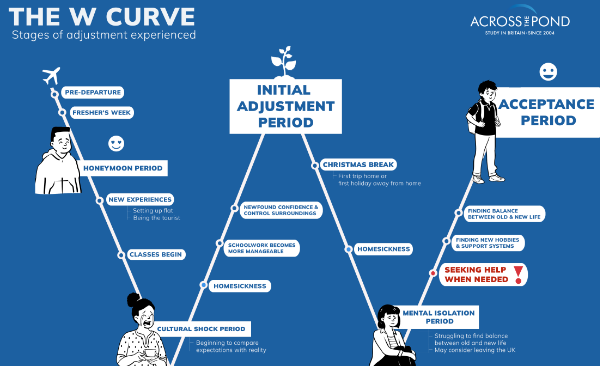
CLICK TO SEE VIEW FULL-SIZE IMAGE IN NEW TAB
*If you click to open the image, you'll be able to see the full W-curve. It will open in a new tab or browser window so that you can pull it up side-by-side and follow along while reading below.*
The “Honeymoon” Period
Students tend to enter this period before they’ve even left for the UK! Think about it – you’re anticipating your new adventure, and your mind is filled with exciting possibilities! You may be thinking about your programme, meeting new people, eating new foods, exploring new landmarks (being a tourist is fun!)
Similarly, when you arrive in the UK, you’ll be flooded with new student activities that bring on a new sense of independence. These could include participating in your university’s Fresher’s Week, meeting new students, setting up your bank account, moving into your new flat (especially if it’s your first time living on your own!)
The fist few weeks are a whirlwind and often leave little space for students to miss their home.
The “Culture Shock” Period
Once the excitement of your first few weeks wears down, you may start to think about your initial expectations of your programme, location, university etc. and start to compare those expectations with reality. In this stage it’s common to start comparing your experiences with others which may lead students to feel overwhelmed, isolated or homesick.
Some distress and confusion are common here while you question your choices and whether you belong in your new environment. Small differences in your new environment from what you’re used to may bring on further feelings of isolation as you examine cultural differences and familiar resources, or support systems may not be immediately available.
The “Initial Adjustment” Period
Once the initial culture shock passes students start to find successes in their everyday lives. Habits are being made/maintained, schoolwork becomes more manageable, bonds are being made with others and essentially a routine is being put into place.
Your new successes and growth in areas like mental wellbeing, social skills etc. will become more apparent, and students will then be brought back to the initial feelings of excitement. You’ll remember why you were so excited in the first place and start to regain a new confidence and control of your surroundings.
The “Mental Isolation” Period
This stage may occur closer to Christmas break or other academic breaks. Should you choose to go back to Canada and spend time with friends/family, you may find a sense of discomfort in the things you previously loved about home. It’s normal to feel somewhere in between as you navigate your new relationship between your old home and your new home.
It's completely normal to begin re-evaluating certain aspects of your previous life here, and even healthy to reconnect with your own values, as well as the parts of your culture or home country that are most important.
The “Acceptance and Integration” Period
As you continue your studies and start figuring out ways to help you succeed, you’ll regain a sense of confidence and control in your new life once again. You’ll develop better relationships with your peers and tutors and will likely get more involved within your campus environment. Perhaps taking up a new hobby or finding a support system of like-minded peers. Your new home becomes less intimidating, and more comforting as these bonds flourish and will be the cornerstone for maintaining a healthy balance between your old lives and new one.
Need help?
All universities have Wellness Centres and help available to students at different levels. If you’re struggling with mental health, home sickness, or adjustments as an international student, it’s important to know that resources are available to help. Speak to a friend, professor/tutor, university staff (via the international office or wellness centre) and be open to receiving assistance if needed.
You can also reach out to your Across the Pond advisor and we’ll be more than happy to help point you in the right direction for resources or contact information for your university.
While intentions may be good, parents encouraging you to come back or move home after a short time in the UK may not be as beneficial as you think in the long run. Seeking professional guidance can help you migrate these feelings and help you adjust to your new surroundings in a way that promotes growth and flourishing.
No two journeys are going to be the same, and that’s okay! Focus on your own journey and determine what you need to help you succeed in your studies.

What to Do with Your Pet While Studying Abroad
Written by Advisor Brittany - 30/01/2025
It can be hard to leave your furry friend behind as you embark on your new adventure, but ultimately there are a few reasons why it’s best to leave your pet behind (with family or a trusted friend/partner) while you’re in the UK.
-
Most university accommodation will not allow pets. This is because animals (especially dogs and cats) may cause allergies with some students. This does also typically extend to emotional support animals so do keep that in mind. Unless your pet is a registered service/guide animal, it is extremely unlikely that they would be allowed to stay with you on campus.
This would result in you looking off-campus for your accommodations (which can be tricky to secure as an international student, especially in your first year of study). Never assume the university’s policies! Do check with your UK university as soon as possible if you think you may wish to bring a pet with you to the UK. They may have staff on hand to help with questions. - Entering the UK can be stressful and expensive for both you and your animal! If you think you may want to bring your pet with you, it’s extremely important to review the official UK government guidelines as early as possible. You can do that here: Take a Pet Abroad (you’ll find Canada in the ‘part 2’ listed country list.)

If you’re thinking of taking a dog (for example), your dog may need to undergo several vet visits to ensure it meets the requirements for Canadian exportation and UK importation.
Shots have to be given at least 21 days before flying. Mostly, you will have to get a microchip implanted (if not already done), the rabies shots, and have your vet fill out the health certificate which you should be able to obtain from the UK government site.
It is extremely important to check the pet requirements for any airline that you’ve booked with (or plan to book with) as well! Many, if not all airlines are prevented from allowing pets in the cabin when landing in the UK. As these are long flights, being in the cargo area can be quite traumatic for animals.
Overall, we recommend leaving your pet at home while you’re abroad. As hard as it may be, there are some great ways to cope with missing your pet while you’re studying:
How to Cope When Missing Your Pet
Think of the positives!
If you do plan to go home in between semester breaks, or during the summertime, your time apart will actually be shorter than you think. The structure of UK semesters and breaks typically allows for longer breaks every 4 months or so. It’s still a long time, but you won’t necessarily be away for your entire degree!
You can also video chat with your pet (with the assistance of friends/family members) so that you can see/speak to them while you’re gone.
Many universities will bring local dogs to campus to help with student stress! If you see them on campus, they’re usually more than happy for some scratches.
Find part-time employment or volunteer with animals!
On a student visa, you can work up to 20 hours during term time. Why not find employment or volunteer at a local animal shelter? Some shelters will welcome the extra hands for things like dog walking. This is a great way to get some exercise, add to your resume, and spend some time with a new furry friend! 
Visit a cat café
These cafes are becoming increasingly popular! Many will highlight rescue animals, or have the animals up for adoption, but as a student you can head down for a cup of coffee and get some cat snuggles in while you’re at it! What better way to spend a few hours? Some options include:
Purrple Cat Cafe – Glasgow
Maison de Moggy - Edinburgh
Java Whiskers - London
Kitty Cafe – Leeds, Leicester, Nottingham, Birmingham
We understand that nothing can replace your furry friend at home, but while you’re completing your studies, there’s no reason why you can’t have a substitute to help get you by! Just think of all of the stories you can share with your pet when you get home!
More of a dog person? Book a session at a dog café instead!
These cafes usually have entrance fees to help continue providing the best environment for the dogs (anywhere from £5 - £10) . But really, who can put a price on spending time with these precious pooches? Make sure you review all policies prior to making your journey.
https://www.cuppapug.com/ - with locations in Manchester and London
https://dogandscone.com/ - Newcastle
https://edinburghchihuahuacafe.co.uk/ - Edinburgh

How to Write a Professional Email to UK Universities
Written by Advisor Lauren - 08/05/2024
As you are applying to university, you may find you need to contact your chosen university by email. Writing a professional email is an important skill you can take with you for emailing professors, applying to jobs, and within future careers. Read on to find our top tips for writing a professional email during your applications to UK universities!
Formatting Your Email:
Make sure to use a professional email address that you check often. For example, your previous university or school email is usually fine, but if you have already finished your studies at that institution it's a good idea to check with them how long your email address will remain active. Some schools will cancel the emails of graduates after a certain period of time.
You can use a personal email address that you've created yourself instead don’t use something like coolguy@gmail.com, as this seems unprofessional. You should also make sure to check what the display name on your account is as well, as the universities will be able to see this. Our advisors have seen many students who had previously changed their display name as a joke and then forgotten about it.
Some students opt to create a brand new email address just to use for their university applications to keep things organized. This isn't a problem as long as you remember to check it regularly. If you are thinking of doing this, consider setting a calendar reminder or alarm for yourself to prompt you to check your email multiple times a week (if not daily).
Subject Line:
The subject line of your email should be short, concise, but tell the receiver what the email is about. When emailing a university, always include your student or reference number. For example:
ID:12345678 + Visa Question
Avoid using words like “Urgent”, “Please Respond”, etc. in your subject line, unless it truly is an urgent email - if every email the university received was marked urgent, there would be no way to differentiate the emails that actually are.
Finally, check the font you are sending your email in – something legible, like Times New Roman, Calibri or Arial is fine, in size 11 or 12-point type. Do not use all caps, or unnecessary highlighting or colour.
How to Start Your Email:
Your email starts with your salutation. This is where you address your email to the recipient. If you know their name, include it. For example:
“Dear Mr. Smith,”
If you don’t know their name, something more general like:
“Dear Sir or Madam”, or “To whom it may concern”, or “Dear Admissions,” is fine.
Do not ever just say “Dear Sir” or “Dear Madam”– you do not know the gender of the person answering your email, and should not assume.
“Dear” is the more formal address – avoid saying “Hello,” “Hi”, etc.
Feel free to follow the address with a kind greeting, such as “I hope this email finds you well”, but this is not required.
Composing Your Email:
You should introduce yourself to start the email. List your name, the course you applied for, and the purpose of your email. For example:
“My name is John Smith, and I have applied to study BSc Archaeology and X University. I have a question about my offer conditions.”
From there, make sure to be concise, explaining as clearly and briefly as possible the reason for your email, so that the recipient can best assist. For example:
“On my offer letter, I was asked to provide IELTS results. As I completed a degree in English in my home country, I was wondering if this condition could be removed? Thank you for your assistance.”
Try not to drag the email on – it is completely fine for your email to only be 2-3 sentences, as long as the reader can understanding why you are emailing, and what they need to do to assist.
Make sure you use formal language – avoid slang terms, unnecessary contractions, emojis, profanity, or jokes. Always write in complete sentences, and check for any spelling errors.
Completing Your Email:
Make sure to use a formal closing, don’t leave your email open ended. There are several options you can use, but it should read as though you are signing a letter. Phrases like “Sincerely,” “Respectfully,” “Best wishes,” are all fine, followed by your name on the next line, and your student number again. For example:
“Best wishes,
Jean Valjean
24601”
Proof-Read:
Before sending, check that the email address of the recipient is correct and the name (if known) is spelled properly. If you have stated in your email that you will provide an attachment, make sure it is attached. Check again for spelling and grammar, and then you are ready to send!
Once you have sent your email, you will usually receive an automatic reply, which often states the standard timeline for a reply. There is no need to reply to this email. Keep in mind that you will only receive a response during the recipients work hours – and that those work hours will more than likely be in the UK. If you don’t receive a quick response, that is not unusual.
If you don’t receive a reply, it is fine to send a follow up approximately two weeks after your initial email. Following the rules above, be polite, and simply say:
“Hello ,
I hope you are well.
I would just like to follow up on my previous email. If you require anything further, please let me know.
Best,”
With these tips, you should successfully be able to send a professional email, and find success with your studies! Need more help or advice with your applications? Let our advisors guide you through every step!

How Across the Pond Helps During Student Visa and Pre-Departure Season
Written by Mackenzie - 29/04/2021
If you’ve accepted an offer to a UK university (or are planning to soon), congratulations! You’re probably thinking – now what? Don’t worry! Your Across the Pond advisor is still here to help with the remainder of this process. Read on to find out more about the FREE assistance we can offer during student visa and pre-departure season!
STUDENT VISAS
Do you need a student visa? If you are not a a UK citizen and do not have a valid UK passport, then you will most likely need a student visa to study in the UK.
STUDENT VISA GUIDE
Across the Pond puts together a comprehensive student visa guide annually. Typically, we send this out around May for students starting in the fall. We wait until May so that the information in our guide is as up to date as possible at the time of publication, though students should also be sure to check the UK’s official student visa website for updates post-publication.
*Reminder: please do not apply for your visa until prompted to do so!*
Our guide highlights key areas of the official UK Home Office Visa Guidance that apply specifically to the Student Route Visa. We do our best to make the official information as clear as possible.
Despite the resources that we offer, it is important to note that we are not qualified immigration lawyers/advisors. Therefore, we are not able to provide advice on application specifics, and it is your responsibility to ensure that you meet the requirements and submit all the correct documents with your visa application.
VISA CONTACTS
For visa questions about your personal circumstances, we can direct you to the appropriate contact at your UK university. They will be able to provide more tailored advice and have a wealth of experience advising international students! Just let your advisor know and we can help put you in touch!
Alternatively, questions regarding your personal application can be directed to the UK Home Office. Please note that we cannot advise on individual visa cases and can only give the general guidance as offered by the Home Office.
Home Office: Contact UK Visas and Immigration for help - GOV.UK (www.gov.uk)
STUDENT VISA WEBINARS
Across the Pond runs student visa webinars each spring. An advisor will run through a presentation on the visa application process and hold a Q&A. Your advisor will let you know when these visa webinars are happening!
PRE-DEPARTURE INFORMATION
When we say “Pre-Departure” information we refer to advice that will help you in your departure preparations and arrival in the UK!
PRE-DEPARTURE GUIDE
Going to study in the UK is an exciting experience and we know that you will have many questions. For this reason, Across the Pond has created a Pre-Departure Guide! It’s designed to help answer your questions about the practical aspects of moving to the UK, and provide information that should be useful throughout your journey!
PRE-DEPARTURE WEBINARS
Additionally, our team runs pre-departure webinars every summer. While the visa webinars are more instructional, this webinar is meant to be fun! We cover some of the most frequently asked questions about travelling/moving to the UK, and answer your questions live!
FACEBOOK GROUPS
Each year, we create Facebook Groups for our students! This is your space to meet other Across the Pond applicants who plan to start their studies at the same university. Your advisor will send you the information for these groups in the spring/summer. We post some fun and helpful information in these Groups so we encourage you to join if you are going to be attending one of our partner universities!
BLOG AND SOCIAL MEDIA
Across the Pond’s blog is a GREAT resource for pre-departure information (hello, you’re in it!). With articles written by both advisors and Across the Pond students, the topics are extensive! You can find our (awesome) blog homepage here and use the category filter to check our our predeparture posts.
Just because your application has been sent, doesn’t mean the end of Across the Pond’s free services! We are here to help you every step of the way on your journey. If at any time you have questions, let us know!
You can find out more about studying in the UK by contacting one of our advisors!

How to Handle being Homesick While in the UK
Written by Kiranpreet - 01/08/2023
It has been around 3 months since I first arrived in the UK. Throughout my time here so far, I have gone through a lot of emotions. First: being excited to start a new chapter in my life, second: being nervous to make friends and feel at home, and third: feeling content with where I currently am in life.
Excitement
Excitement is what will help you experience the first couple weeks in the UK without feeling homesick. The first week, I had my mom come with me to help get my room sorted and adjust to the UK lifestyle. This was very beneficial as I didn’t feel overwhelmed with having to do everything myself. Many students, of all ages, had their parents or someone come with them and it truly does help with transitioning into living on your own (especially if you haven’t before). With so much change happening, such as moving to a new country, a new language for some, new rules, new time zone, etc.; a whole bunch of newness, having someone with you, helps to completely change your life.
Nerves
Nerves are a big thing; this is what hit me once my mom left and school had finally started to pick up. The nerves made me feel lonely and homesick. However, a huge tip I can give is to talk to people. Try to socialize, and not stay too alone for a long period of time. Whenever I felt homesick, I would call my parents and friends back home, but I would also ask my friends here in the UK to hang out. It helps to get your mind off of things, and chances are they are 100% feeling the same as you. Contacting you Across the Pond advisor can also be an option, I believe all of the advisors have experienced university abroad and they can definitely speak from experience and provide tips.
Content
Feeling homesick is hard, especially when you aren’t only a couple hours away. Moving to a new country can be extremely difficult, however, getting through the first couple months (which are the hardest) is worth it in the end.
My top 10 tips would be to:
- Bring someone with you if possible, to help with the transition
- Put yourself out there, make friends and socialize
- Talk to someone if you’re feeling alone or homesick
- Plan trips or activities for the weekends to avoid feeling homesick
- Call home, if you’re feeling homesick, chances are you are being missed too
- Make the best out of your time here in the UK
- Watch videos on feeling homesick
- Develop a routine to avoid feeling like you have nothing to do
- Talk to an Across the Pond advisor
- Enjoy!! Feeling homesick will only last so long, it will get easier. Enjoy your time in the UK and live your best life!
Homesickness is just one con of moving to the UK, however there are SO many pros. There are such great friends, opportunities and self-growth that I have achieved since moving for law school. I highly recommend making this choice for yourself.
Interested in studying in the UK? You can find out more by contacting one of our advisors!